

I hope you forget me.
A father's meditation on memory, progress, and the paradox of wanting to be forgotten

I want to be remembered, and I want to be forgotten. Not at different times, and not by different people—I want both things simultaneously, completely, and for the same reason: love.
Someday—perhaps many generations from now, perhaps much sooner—my beliefs will feel as antiquated as a rotary phone. The ideologies that I hold dear will reveal themselves as relics of my particular moment in history, and the collective will move beyond the limitations of my perspective.
Hopefully, I will continue to learn and grow into old age—but even if I do, my words will exist in conversation with the time that I spent on this earth. Future generations will read them the way we read century-old advice about marriage or child-rearing: with bemused curiosity about how differently people used to think.
This progression is already visible in my own home. At three years old, my daughter moves through the world with a confidence that still catches me off guard. She believes she deserves to be heard. She expects her ideas to matter. She stands on business.
She assumes the world will make space for who she is—assumptions that took me decades to even consider, let alone embrace.
This isn't because we're the greatest parents in the world. We're just people— people who love her fiercely. People who happen to stand on the shoulders of those who loved us the same way. Ordinary people who work hard and just so happen to stand on the shoulders of giants. My father, raised by sharecroppers in the South, who went on to become an officer in the United States army. My mother, who graduated from high school at sixteen to escape Chicago and take control of her fate.
They made countless sacrifices to give my brother and I a better life—a life that their parents couldn't have imagined. Now my wife and I seek to extend that trajectory—to hoist our daughter onto our shoulders so that she can see even further into the distance.
It's not always easy to believe that a better world is possible for future generations, particularly now. We are living through what feels like a dark and pivotal period for humanity—a time when progress seems fragile, when institutions feel brittle, and the very notion of collective advancement can seem naive.
But it is my fervent hope that when we zoom out far enough, the arc of history continues to bend toward something better. Like countless parents before me, I want my daughter to inherit a world more beautiful, more just, and more full of possibility than the one that was handed to me.
Here's the paradox: as I hope for a better world, I am also hoping for a world that renders much of my current worldview irrelevant. I am hoping for a world that has solved the problems I spend my life wrestling with so completely that my struggles seem unnecessary.
At some point, if humanity lasts long enough, I might be looked back upon like we look back upon the man who discovered fire. Or, I might not be remembered at all.
In due time, that will be for the best—because at some point, memorializing and remembering me as above critique will limit someone else's growth.
My beliefs may serve me well in 2025, but I do not want them to be used as an excuse for someone's stagnant thinking and outdated beliefs in 2125.
I am a well-intentioned man shaped by patriarchy, raised in the shadow of Christian nationalism, and trained in the language of respectability politics. This isn't me being hard on myself—it's a sober acknowledgement. My politic has evolved beyond my upbringing—but that doesn’t change the fact that my existence is shaped by multiple legacy systems that should be dismantled by future generations.
Some days I think I'm making progress. Other days I discover new ways that I've been complicit in my own limitations. And sometimes, I can understand how my self-imposed limitations also impede the progress of people I love dearly. But even on my best days, I know that there are so many things that I do not know. Things that I will never know.
My daughter might understand these things one day, if I’m smart enough to get out of her way.
And so, to future generations: I’m not smart enough to know how soon this will be necessary—but when the time is right, I hope you forget me. I hope you forget me entirely, because I would rather be forgotten than serve as an outdated crutch limiting your ability to think beyond my imagination.
I do want people to read my work. I do want people to know my name. I want to be seen, and heard, and felt. My ego exists. But that need to be seen comes with an expiration date—because when I depart from this earth, my pride will not be among the things that outlive me.
What I hope will outlive me are the cultural shifts my work might contribute to, the conversations it might spark, the small changes in perspective that ripple outward long after my name is forgotten. I hope you read one of my books, only to forget about it years later because better thinkers emerged who built upon ideas I helped plant.
I hope you forget how to pronounce my name—not because you think my name is “Michelle” like so many of my contemporaries, but because there are so many brilliant writers, thinkers, and doers in the generations to follow that my contributions are simply a footnote in a much larger, more beautiful story.
The Work of Becoming Forgotten
This raises a question that extends far beyond my personal ego: if we're doing our jobs as writers and thinkers, shouldn't our ideas resonate further than we could ever travel on our own two feet? Shouldn't our thoughts contribute to conversations that we are not qualified to lead—conversations that will happen in rooms we'll never enter, among people who will build upon our ideas in ways we never could have imagined?
The most radical act of love we can offer future generations isn't ensuring they remember us. It's ensuring they have the freedom to forget us when forgetting serves their growth better than remembering. It's working toward a world where our struggles become so obsolete that they seem quaint.
I hope we build a culture where everyone not only consumes, but also creates. Where everyone not only observes, but also connects. Where we don't need to look to any particular group of people for inspiration, but instead find it in our own communities, and in ourselves. Where each person experiences the belonging and fulfillment that comes with being one voice in a brilliant chorus.
Two Types of Memory
But there's a difference between the memory I crave and the memory that matters. I hope I'm forgettable on the internet, because I was able to pour more deeply into the people I have the pleasure of loving in real life.
I hope my family remembers the way my forehead crinkles when I laugh. I hope my friends remember the way my voice sounds when I call to talk about absolutely nothing. I hope my daughter remembers how we dance when her favorite songs come on. I hope my wife remembers our Monday afternoon dates.
These intimate memories—the texture of a life lived in relationship rather than in pursuit of recognition—these are the memories that matter to me. Not because they're more noble, but because they're more human. They’re tied to my humanity, not my need for recognition.
The Long View
I hope that my great-great-great-grandchildren will inherit the wisdom and courage to articulate that their great-great-great-grandfather meant well, but had some problematic views that needed to be transcended. I hope they'll understand that loving someone doesn't mean accepting everything they believed, and that honoring the past doesn't require us to be constrained by it.
This is what progress looks like—not the preservation of individual legacies and personal agendas, but the courage to build on the foundation others provided while having the wisdom to renovate what no longer serves.
In a world obsessed with personal brands and digital permanence, perhaps the most countercultural act is working toward our own obsolescence—planting trees whose shade we'll never enjoy, solving problems so thoroughly that future generations can't imagine they existed.
To love the future more than we love our place in it. My ego will die with me. My pride has no afterlife. When I leave this dimension, my need to be remembered goes with me.
That's the work. That's the hope. That's the gift we can give to people whose names we'll never know, in service of a world we'll never see, but helped create nonetheless.
And if we do it right, they'll never need to thank us for it.
I am deeply thankful for your support. If my words have helped you in some way, please consider sharing them with others. If you have the means to do so, you could also support my work directly by upgrading to a paid subscription.
If you’re a paid subscriber, I can’t wait to start hosting you for my monthly creative workshops!
The workshop series that I’m preparing to host right now is called EMBODIED AUTHENTICITY: creating with purpose in a distracted world.
This is a 10-part workshop series for creative entrepreneurs ready to break free from algorithmic pressure, create work that matters deeply to them, and win on their own terms.
It is the culmination of what I've learned through my own healing journey, 10+ years of creating content, and a lifetime of turning personal struggles into stories that help others find their path forward.
We start on August 10th, at 8PM EST!
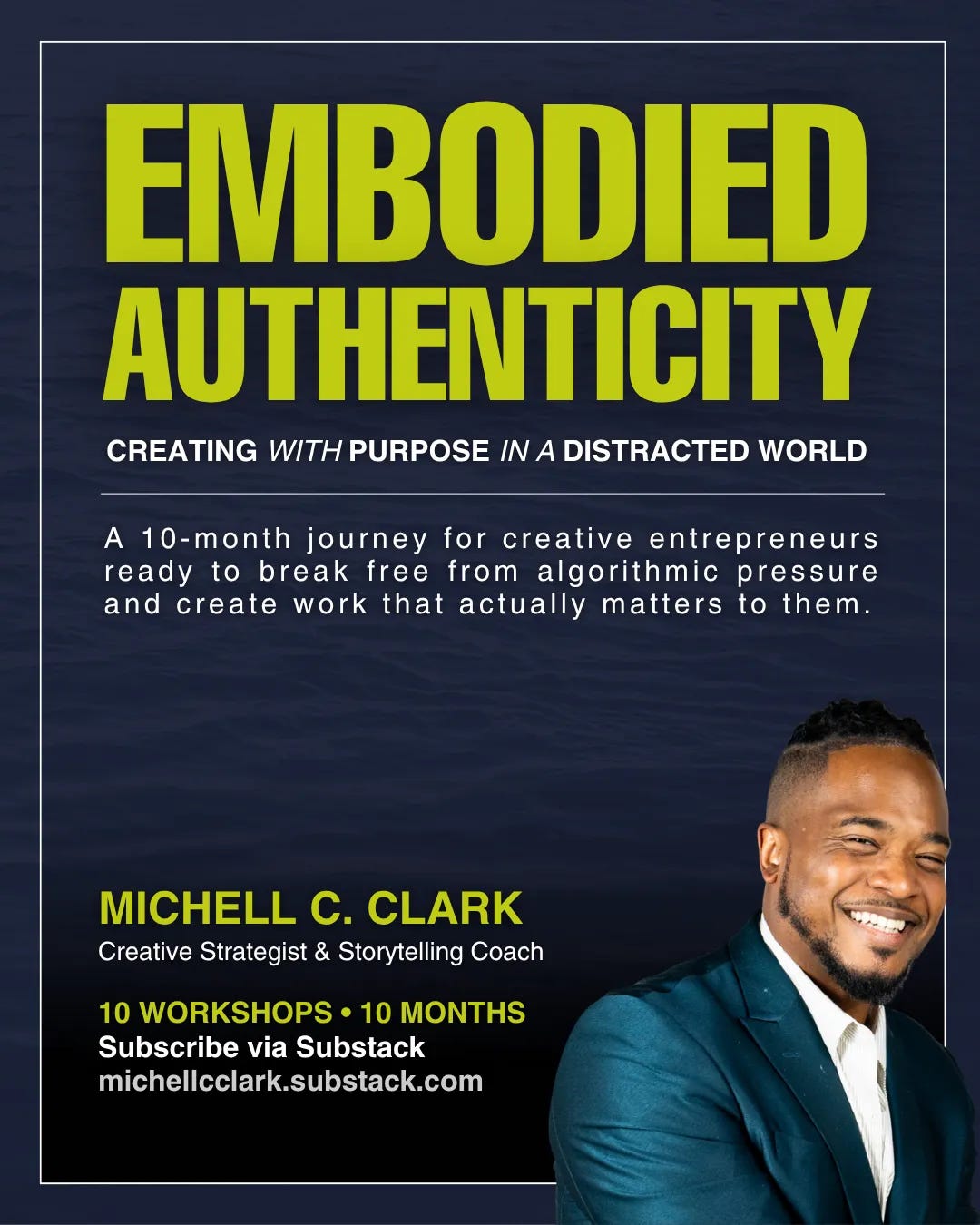
I'd love to welcome you into this new community, at the subscription model price point of $6.99/month or $60/year.
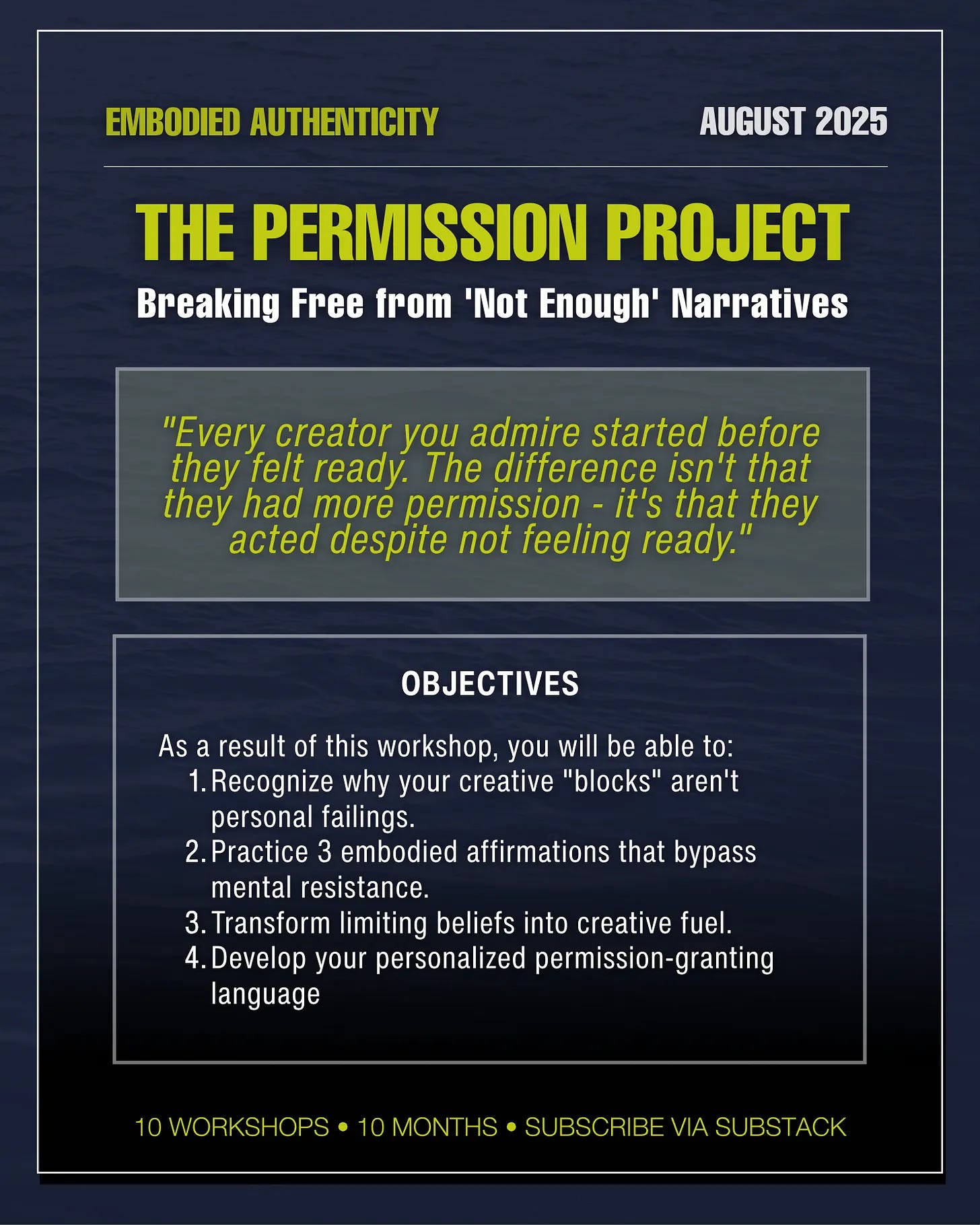
The first workshop is entitled The Permission Project. Paid membership will get you access to the live workshop at 8PM EST on August 10th, and access to the replay. I’d love to have you.
What a beautiful post full of wisdom. If only everyone could have this perspective. And also, I love the dichotomy of being forgotten and remembered.
You never let us down Michell. Thank you.
How many interactions of each of our lives do we wish to be remembered and forgotten?